

“100,000,000 years” by @abdulmazid_ ! Be sure to check out his solo exhibition up through August #shoshanawaynegallery #abdulmazid
News
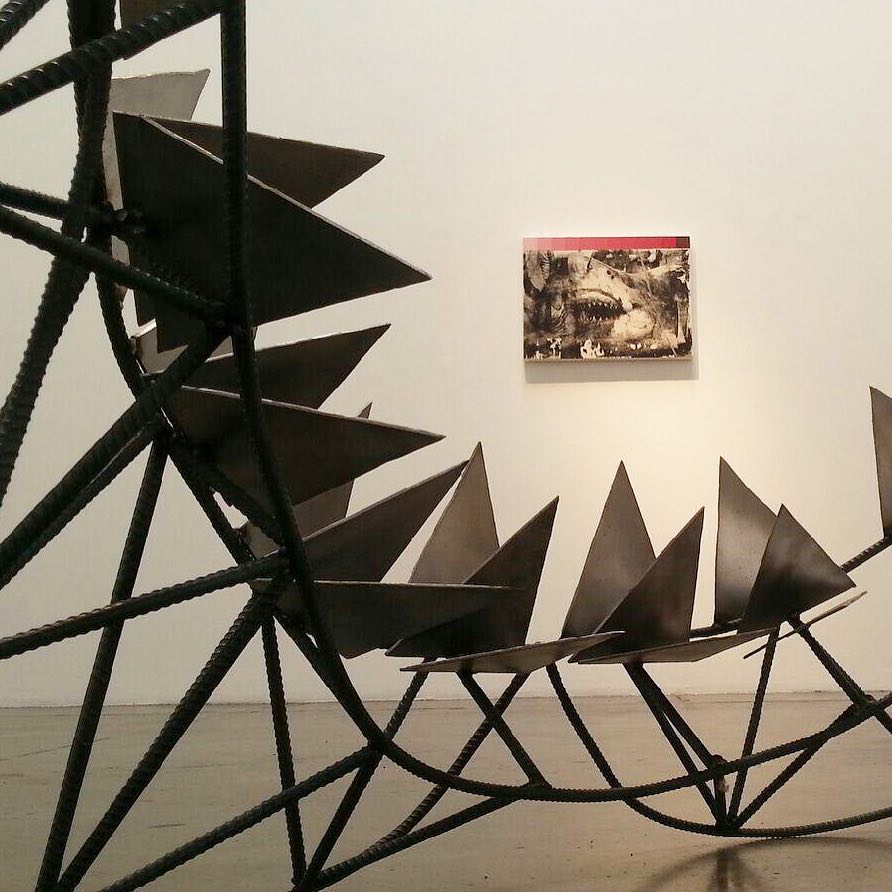
Join us tomorrow for the opening of Abdul Mazid - “Observations in Nature”! #shoshanawaynegallery #abdulmazid #art
Join us for the last few days of “Fill: Content-Aware”! #shoshanawaynegallery #olivermichaels #video #art

@latimes reviews Oliver Michaels! #shoshanawaynegallery #olivermichaels #latimes #art

Opening TONIGHT! Oliver Michaels: “Fill: Content-Aware”, 5-7 PM #shoshanawaynegallery #olivermichaels #art

Join us for the final day of Sabrina Gschwandtner’s “Film Quilts”! #shoshanawaynegallery #filmquilts #sabrinagschwandtner

Don’t forget to come in for Sabrina Gschwandtner’s “Film Quilts”! On view through April 18 #shoshanawaynegallery #sabrinagschwandtner #filmquilts

Sabrina Gschwandtner, “Peruvian Weaving: A Continuous Warp”, 2015 #shoshanawaynegallery #filmquilts #sabrinagschwandtner

Visitors currently checking out our opening reception with @filmquilts #shoshanawaynegallery #sabrinagschwandtner #filmquilts

Opening February 21 - Sabrina Gschwandtner’s “Film Quilts”! #shoshanawaynegallery #sabrinagschwandtner #filmquilts

Philip Argent, “Untitled”, 2014 #shoshanawaynegallery #philipargent #rhizome

Izhar Patkin, “Gardens for the Global City” (series), 1991 #shoshanawaynegallery #rhizome #izharpatkin

Opening night of “Variations: Conversations in and Around Abstract Painting” @lacma #tbt #RachelLachowicz #LACMA #shoshanawaynegallery

A little preview of tomorrow’s exhibition! #shoshanawayne #dinhqle #rhizome

Setting up for the opening of “Rhizome: Multiplicities of Abstraction”! Join us Saturday, Jan. 17th, 5-7 PM! #abstract #art #shoshanawayne #philipargent #rachellachowicz #dinhqle #abdulmazid #olivermichaels #izharpatkin #elainereichek #jamesrichards #beverlysemmes
Visual Art Source Review - Jeanne Silverthorne

Editorial: Features
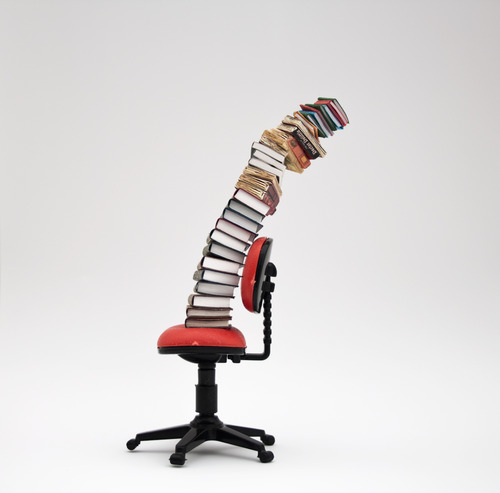
Jeanne Silverthorne
Shoshana Wayne Gallery, Santa Monica, California
Review by Suvan Geer
Continuing through January 3, 2015
Jeanne Silverthorne casts her sculptures in synthetic rubber and with that surprising physicality she earnestly but also playfully autopsies the life out of the contemporary world. “Down the Hole and Into the Grain” is the artist’s continuation of an ongoing examination of nature morte, (dead nature) that plays on the tradition of still life. The translucent softness of the rubber, which Silverthorne has referred to as a kind of “flesh”, makes familiar objects selected from things in her studio and daily life decidedly strange and provocative. Pseudo rolls of wood grained flooring, huge lumber packing crates, blooming flowers, dentures and rolling wood dollies all drop their physical ties to the natural world and become oddly artificial in ways both layered and disturbing.
The artist says in her statement that she is “looking for something that has been lost”. Displayed here in neat aisles like preserved specimens from an underground vault her color-blanched objects offer us the opportunity to ask questions about what is about the natural world that generally goes unmissed in a world of rampant representation and life-like simulation.
What indeed are the signs of life in our brave new world? Living things have an animating force; they move and reproduce. Technology and science have copied and messed with that simple formula until the boundary between naturally alive and life-like is a blur. Silverthorne joins in the fray. In the past she has constructed sculptures that used mechanics to actually move. Some of these sculptures potentially glow in the dark like bioluminescent denizens of the deep, but none of them actively move. Instead Silverthorne parodies procreation. By copying in miniature some organic shaped chunks of rubber left over from the oozing mold making of her sculptures she laughingly treats her fabrication process as female labor and the ongoing copies she makes of the real world as a simulated progeny. It’s a clever shift.
Living things however, also die. Silverthorne’s sprawling coils of cast electrical cable, naked silicone light bulbs, and rubber power boxes give us the industrialized world’s version of life’s animating force reframed as instruments of allegory. With them she brings us to the weirdly absurd activity of considering still life in a world of simulation. Her limp rolls of wood grained rubber flooring signal the process of natural decay by sprouting clumps of equally artificial weeds. Some pristine looking unreal planks crawl like rotting logs with similarly unreal bugs or flies. Her simulated lumber shipping crates sometimes sag towards collapse, but others sit like pale graphic shrines displaying miniature cast self-portraits or posthumous sculptures of people from the artist’s life. In these small figures a pinch of real human hair wildly erupts from each of their colorless little heads. The hair, like growth rings on a tree, is a residue of actual living growth. But here it stands out as the hairline demarcation between life and a manufactured life-like representation. (I have a feeling that visual pun, like others in the exhibit is intended).
All the tromp l’oeil crossovers between real and artificial life and death make for quite a hallucinogenic journey. There are piles of rubber scraps teeming with fake caterpillars, a colorless black and white sunflower committing a slow suicide with a noose made from the cord of a useless electric lamp and elsewhere dead flies pile up beside a stack of ignited gummy dynamite. Yet the tradition of still life images as moral messengers pushes us to read more blatant ecologically related life and death messages into pieces like “Top of the World”. In this sculpture a teacher’s desk globe, totally smooth and eerily white, empty of seas or landmasses, sits beneath a plastic vitrine on top of a fake crate. At the top of the globe two miniature white skeletons are having sex while big black rubber flies either suckle at the globe or lay lifeless beneath it. It’s an emotional and unsettling vision of natural inevitability given an unnatural, toxic connotation by virtue of the artificial materials. A tidy little parable about this reality I don’t want to remember but still find hard to forget.
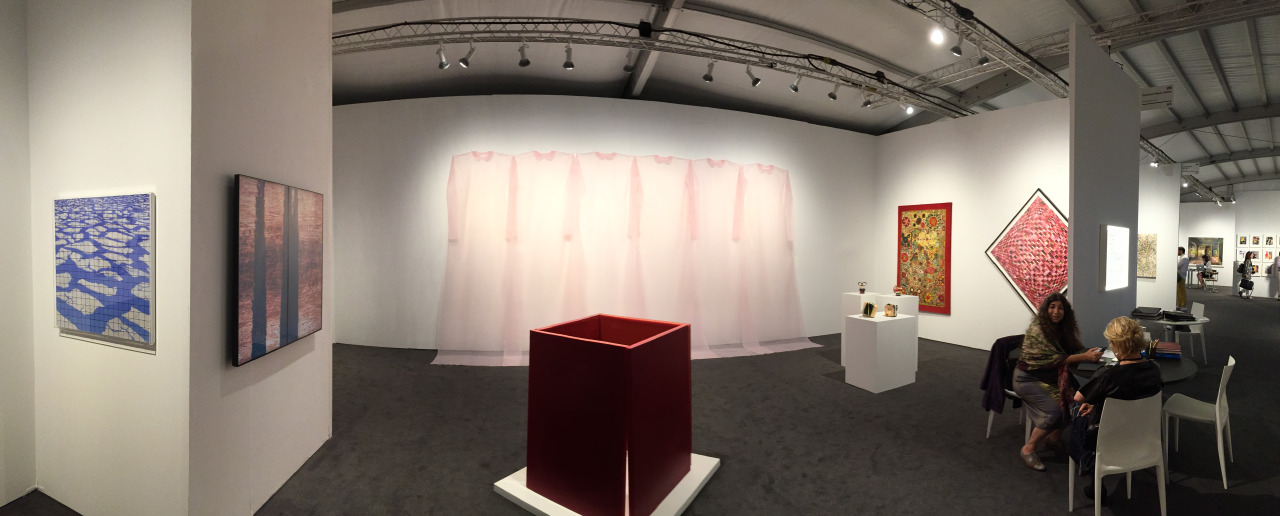


SWG + PULSE MIAMI 2014
Booth A5 / December 4 - 7 / 4601 Collins Avenue, Miami Beach, FL 33140
Rachel Lachowicz featured in Blouin Artinfo

William Poundstone’s Los Angeles County Museum on Fire
October 6, 2014, 7:29 am
“Variations: Conversations In and Around Abstract Art”

LACMA is debuting a couple dozen newly acquired pieces in “Variations: Conversations In and Around Abstract Art.” Gerhard Richter’s St. Andrew (1988) is the frontispiece, but almost everything else was made in the past few years. (At top is an Aaron Curry next to paintings by Christopher Wool and Mary Weatherford.)

Rachel Lachowicz’s Cell: Interlocking Construction (2010) is an assemblage of plastic polyhedra containing blue powders—cosmetic eye shadows. This experiment in feminist chiaroscuro is shown next to Lachowicz’s Lipstick Urinals, 1992, that LACMA bought in 1995. The pairing makes a concise introduction to Lachowicz. You can say the same for groupings by Sterling Ruby, Mark Grotjahn, and Mark Bradford.

LACMA must have been one of the first museums to acquire a Bradford (in 2003). This year it added two large recent works. Shoot the Coin is one of the best in any museum. Carta (above) has a faux basketball that might recall Joe Goode’s milk bottles.

Speaking of bottles, Amy Sillman’s Untitled/Purple Bottle recapitulates a history of postmodern bottle painting, from Giorgio Morandi to Mike Kelley.

Rashid Johnson’s Afro-futurist psychoanalytic couch, Four for the Talking Cure (left), is from a series shown in London in 2012 “inspired by… an imagined society in which psychotherapy is a freely available drop-in service.”
Think contemporary art is an exclusive club? Dianna Molzan’s Untitled (2012) conjoins a frame with a velvet rope.

A downside of the global art market’s feeding frenzy for contemporary art is that even mid-career artists may be unaffordable by the biggest museums. Going by the quality and quantity of what’s on view, LACMA has moved to the forefront of institutional collectors of art here and now.
Nearly all the work in “Variations” was donated by private collectors, and no single name dominates. LACMA is collecting the old-fashioned way, by persuading wealthy citizens to buy top-of-the-line art and donate it to their city’s museum for the good of all. That’s a “variation” from the L.A. model of even a few years ago. Amen to that.
SWG New Artists Announcement


Shoshana Wayne Gallery is delighted to announce we are now representing
Sabrina Gschwandtner
and
Abdul Mazid
!

SABRINA GSCHWANDTNER
Hearts and Hands Brown and Blue
,
2014
Sabrina received a BA with honors in Art/Semiotics from Brown University (2000) and an MFA from Bard College (2008). She lives and works in New York.
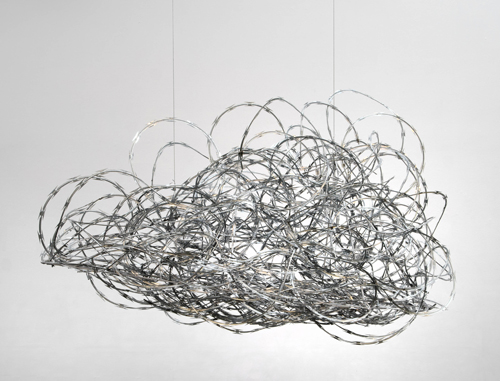
ABDUL MAZID
Occum Nimbus
,
2014
Abdul received a BA in Economics from UC Santa Barbara (2003) and an MFA from Claremont Graduate University (2014). He lives and works in Los Angeles.
Catherine Wagley reviews Yvonne Venegas: San Pedro Garza Garcia
Yvonne Venegas: San Pedro Garza Garcia
Shoshana Wayne Gallery, Santa Monica

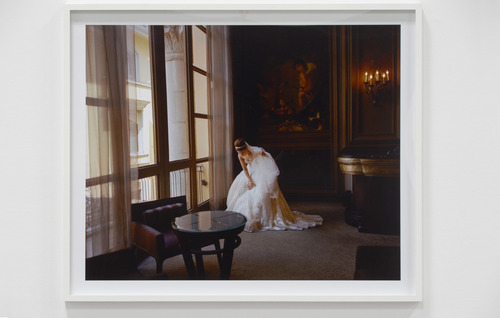
Yvonne Venegas, Zally, 2013. Courtesy Shoshana Wayne Gallery
After finishing school, the Mexico City-based photographer Yvonne Venegas worked for a few years for fashion photographers in New York, assisting Juergen Teller and Dana Lixenberg, two photographers known for walking the line between glamour and grit. Without reading too much into those years, it’s worth noting the respect she gives to her subjects’ beauty, and their desire to be beautiful. She frames her subjects in ways that make them immensely pleasing to look at, even when her images have complicated undertones. In the early 2000s, for instance, she photographed the wealthy matriarch Maria Elvia Hank, looking glamorous and composed, placing Christmas candles on a Reindeer-shaped candelabrum. But a servant bends down behind Mrs. Hank, picking up a candle she has dropped, revealing the infrastructure supporting the smooth presentation.
Venegas’s current exhibition, on view through October 25 at Shoshana Wayne Gallery, is called San Pedro Garza Garcia, after the community it depicts. A suburb of Monterrey in the Mexican state of Nuevo Leon, San Pedro Garza Garcia has a population of about 150,000 and the highest per capita income of any Latin American municipality. This attracted Venegas to it, as did the city’s singular ability to ward off the effects of the drug war that has ravaged so many other Mexican communities.
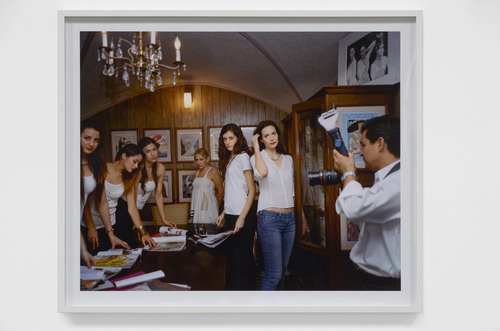
Yvonne Venegas, Rosina and Models, 2013. Courtesy Shoshana Wayne Gallery
Her photographs don’t allude explicitly to this socioeconomic context. Instead, they portray in between moments in an attractive world that appears relatively self-contained. A group of seven models, all brunette and all in white shirts and jeans, look at fashion magazines underneath a chandelier. Three of them level gazes at the camera. A bride, alone underneath a romantic painting of cupid and a candelabrum, adjusts her dress. Two adolescent girls, lanky and maybe bored, sit on a wrap-around beige couch in a living room that’s impressively clutter-free. It’s pristine but languid: The Truman Show meets The Ice Storm. Even her cityscapes, which suggest the existence of a bigger, rougher world, are suspiciously calm.
Venegas’s subjects are mostly unattainable anomalies but her portrayal of relatable moments behind the scenes blurs the abnormality into normality and makes her work compelling. Her images invite you to try to pick apart the roles people are playing, especially in San Pedro Garcia, where it’s clear class and hierarchy matter, but it’s never clear who has what power in the various moments she’s portrayed.
— By Catherine Wagley 09/29/2014


