
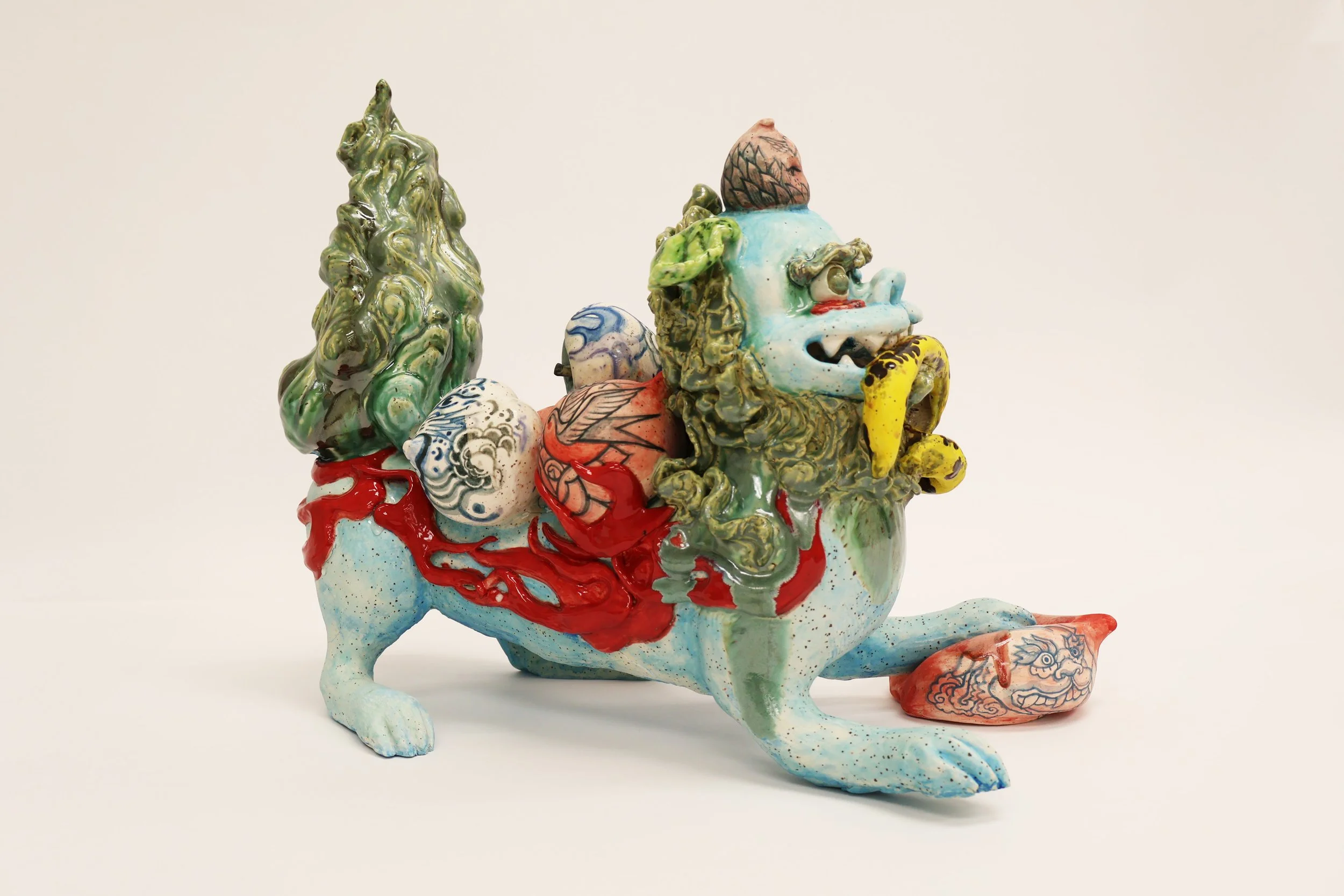
Haetae with Seven Peaches, 2026
Underglaze, glaze, acrylic, porcelain
15 x 20 x 10 in.
Jiha Moon: The Berries, the Wanderers, and the Beasts
Shoshana Wayne Gallery is pleased to present The Berries, the Wanderers, and the Beasts, Jiha Moon’s second solo exhibition with the gallery. The exhibition is on view from November 14, 2026 through January 16, 2027, with an opening reception on Saturday, November 14, from 12–6 PM.
Until recently, Jiha Moon had not thought much about the color red. Now it feels essential.
It appears first as a kind of heat. Across the ceramic sculptures, red moves through tongues of fire, fruit, flowers, and ornament, pooling across some surfaces and flashing at the edges of others. For Moon, red holds beauty close to danger. Its seduction is inseparable from its warning. Lately she has begun to think of it as a color for the time we are in, its urgency bound up with that instability.
Moon borrows familiar protagonists as stand-ins for herself, among them Little Red Riding Hood, a figure she has long returned to as a means of imagining female agency. That duality is carried by the beasts themselves. Moon returns to the Haetae, the guardian figure associated with justice, protection, and the ability to distinguish truth from falsehood. Traditionally understood as a protector against fire and disaster, it appears here caught within the danger it is meant to guard against. Moon has compared these creatures to her own dog, giving the guardian a more familiar, companionable presence. They are protectors that seem to need guarding themselves.
Not every red in the exhibition burns. Some ripen. Peaches, a recurring image in Moon’s work, link Korea to her former home in Georgia. In Korean tradition, the fruit is associated with longevity and immortality; in Moon’s work, its rounded flesh also becomes maternal, bodily, almost anatomical. In Florida, where she now lives, Moon encountered the red spider lily, commonly called the hurricane lily for the season in which it blooms. Across East Asia, the same flower carries associations with death and separation. Roses bring another history of red, one tied to devotion and the Virgin Mary.
Moon builds these sculptures through collision and accumulation. Their ceramic bodies are stacked, pierced, adorned, and joined. A peach becomes a head or an appendage; a mouth pushes outward from the wall of a vessel; feet appear beneath rounded ceramic forms. Painted surfaces meet modeled mouths, limbs, fruit, and ornament, while flames, leaves, ribbons, and animal parts seem to grow directly from the ceramic body. Vessel, figure, and ornament become part of the same anatomy. The exhibition also introduces a new series of pulp paintings, created in collaboration with Dieu Donné, the Brooklyn-based papermaking studio.
For the first time, several of the sculptures also function as lamps, introducing light and utility into forms already dense with protection, danger, and humor. The sacred meets the absurd; the familiar becomes uncanny.
“The Berries,” from the exhibition’s title, is taken from 1920s slang for something excellent. Moon describes herself as a wanderer, searching for value amid uncertainty. In Moon’s hands, even danger leaves room for delight.
Jiha Moon is a 2023 Guggenheim Fellow and a recipient of the Joan Mitchell Foundation’s Painters Sculptors Grant. In 2026, Moon was included in the Chengdu Biennale. Her work is held in major public collections, including the Baltimore Museum of Art, the Fort Wayne Museum of Art, Asia Society, the High Museum of Art, the Mint Museum, the Smithsonian Institution, the Hirshhorn Museum and Sculpture Garden, the Renwick Gallery, the Stanley Museum of Art, the University of Iowa, and the Virginia Museum of Fine Arts. Moon is the Associate Professor at Florida State University teaching studio art at the College of Fine Arts.
